Some people wake before the alarm and finish before almost everyone else has started. The calendar is full and current. The workouts are logged, the sleep is tracked, and the meals are timed. They are always busy, always saying, “I have got to go.” By almost every measure that can be counted, they seem to have energy to spare. Yet somewhere beneath all the motion, there is an unattended terrain: the felt sense of aliveness.
Others tire more easily than before. The afternoons ask for a rest they never used to need. They walk more slowly, do less, and on some days far less than they once did. Yet they notice the warmth in the heart, tension in the belly, thoughts moving through the mind, and a breeze touching the skin. They experience the sky, the trees, the flowers, and the people around them differently than they used to. A child’s smiling face can move them in a way that surprises them. They savor their food without distraction. More often than they can remember feeling in years, they have the sense that they are truly here.
Something is incomplete in the story we have been telling ourselves about energy and vitality. If vitality were simply the result of having more energy, then those in constant motion should feel the most alive, while those moving at a slower pace should feel themselves slowly waning. Yet lived experience does not always follow that arithmetic.
This is not a contradiction to explain away. It is a doorway into understanding vitality.
Where Does Our Energy Go?
We have already seen that energy is not simply fuel to be measured, spent, and refilled. It is living movement felt through breathing, feeling, thinking, and moving. Taoist thought gives us another language for this movement through qi, which gathers and disperses, rises and sinks, opens and closes, warms and cools, and moves continually between what is within us and what surrounds us.
Seeing energy this way brings us closer to the body and to lived experience. But it does not, by itself, explain why more energy does not always create more vitality.
Energy movement has direction. It goes somewhere. Much of it is devoted to basic survival, work duties, family obligations, exercise, entertainment, emotional reactions, and the continual movement of thought. Yet we rarely notice how much of our energy is being directed toward each of these demands. When attention is absent, energy can continue moving while we gradually lose intimacy with the body that is living that movement.
Energy also has duration and intensity. A heated argument, intense excitement, strenuous exercise, prolonged anxiety, chronic stress, strong desire, and deep joy all mobilize energy differently. The question is not only what we feel in the moment, but what happens afterward. How does the body respond when energy rises strongly? What happens when activation persists? What allows us to settle and replenish? Without awareness, we may become familiar with certain states without understanding what they are doing within us.
Energy is also a living force that continually meets the world. It responds to sound, smell, light, taste, touch, temperature, and the presence of other people. It moves toward what attracts us and away from what threatens us. It bonds and protects. It reaches outward, withdraws, pushes, yields, welcomes, and resists. These interactions shape us even when we are barely conscious of them.
Vitality requires a different degree of relationship with these movements. It asks us to notice where our energy goes, to feel how it manifests through us, and to cultivate the way it moves within us and responds to the world around us. Energy keeps life in motion. Vitality concerns how fully and deeply we are able to notice, feel, and participate in that motion.
Before Life Becomes Achievement
Before life becomes achievement, identity, responsibility, or performance, it is experience.
Light enters the eyes before we decide what to look for. Warmth reaches the skin before we name it. A voice arrives in the ears before the mind interprets its meaning. We are alive first because we can sense the world and ourselves, and these are not always separate territories. Much of what we know about ourselves arises through meeting what is around us.
A child sitting at a window watching rain slide down the glass is not doing anything that could be measured as productive. Yet the vitality of such a moment can be unmistakable. The child is not trying to achieve an outcome. Attention, sensation, curiosity, and the surrounding world are simply meeting within one experience.
Somewhere between childhood and the middle of life, many of us learn to filter more and more of this experience. We learn to notice what is useful and overlook what is not. We learn to attend to what advances the story we are telling about ourselves and to set aside what seems irrelevant to it. Energy that once moved readily through sensing and responding may become increasingly organized around managing, performing, proving, protecting, and keeping up.
None of these activities is inherently wrong. We need structure, work, goals, protection, and responsibility. The difficulty begins when nearly all of our energy becomes directed toward maintaining the outer shape of life while our contact with the life occurring within it becomes thinner.
We eat without tasting. We listen while preparing our reply. We look while scanning and evaluating. We walk with little awareness of the body or the surrounding world. We rest while calculating how quickly the rest should restore us. We socialize while comparing and performing. Even pleasure can become something to schedule efficiently.
Vitality may begin to fade not because energy has disappeared, but because less of that energy is available for directly experiencing the life we are living. The waning of vitality is not always a loss of energy. Sometimes it is a loss of our capacity to experience life as it is and to let that experience matter.
Striving over Living: Scale, Maintain, Defend
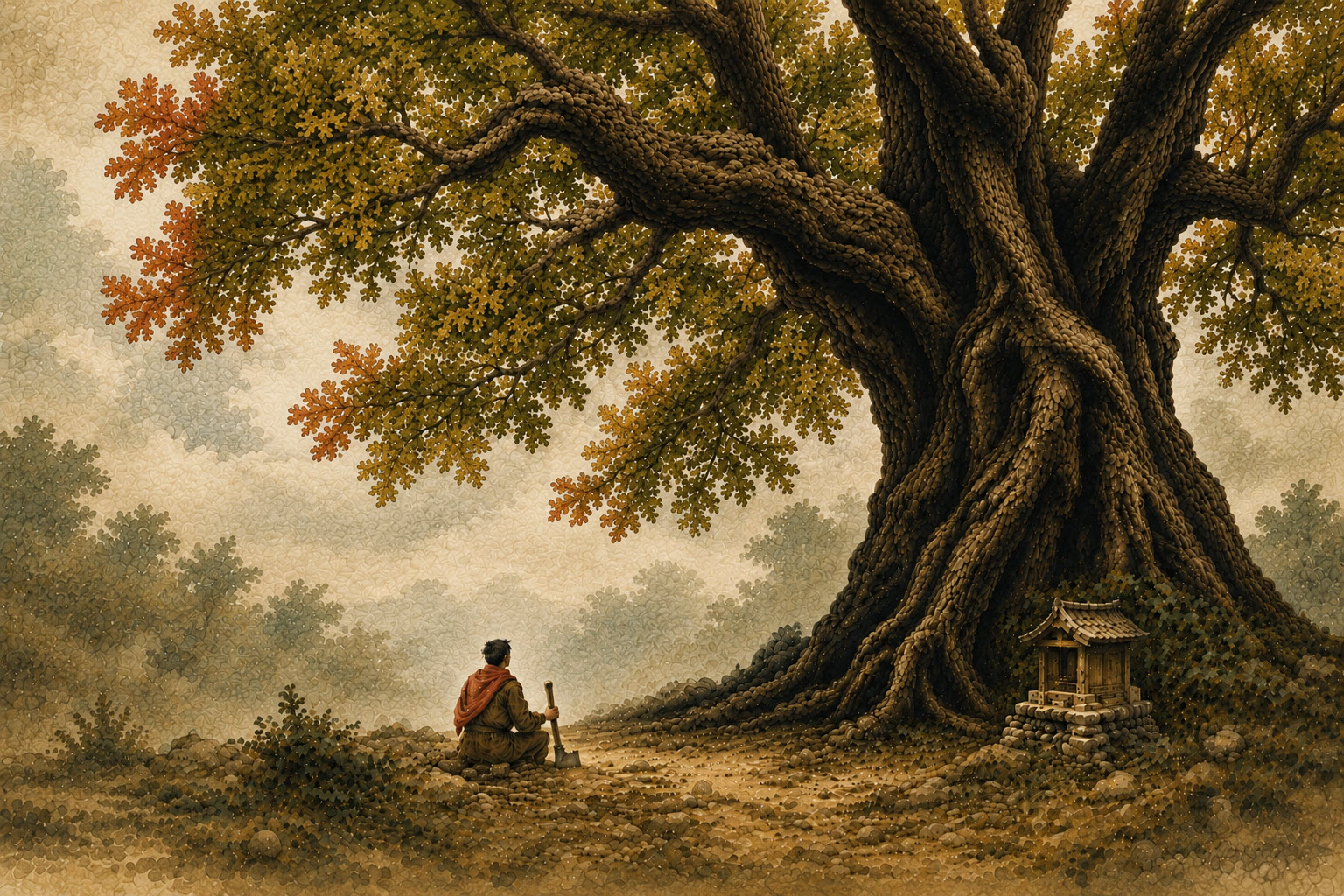
In the Zhuangzi, a carpenter passes an enormous old tree growing beside a village shrine. Its trunk is gnarled, its branches twisted, and its wood unsuitable for almost anything the carpenter values. He dismisses the tree as useless.
That night, the tree comes to him in a dream. Its uselessness, it explains, is precisely what has allowed it to live so long. Useful trees are cut down for lumber. Fruit trees have their branches broken for what they produce. What people value for its usefulness is often consumed by that very usefulness. The tree asks the carpenter to consider whether being useful is always the blessing he assumes it to be.
The story is not really about trees. It is about what happens when a life organizes itself entirely around being useful, productive, and worth choosing, until usefulness begins to take the place of living.
Much of our energy is naturally devoted to survival. The body regulates temperature, seeks nourishment, repairs itself, responds to danger, and preserves the conditions necessary for continued life. Human survival in modern life extends further. We work, provide for ourselves and others, maintain relationships, fulfill obligations, and protect our place within the social world.
But human beings rarely stop at survival. Once basic needs are met, we often continue moving in the same direction. Survival becomes scaling.
We strive for more achievement, more recognition, more possessions, more privilege, more power, and more influence. The question gradually changes from Do I have enough? to How much more can I have?
Scaling is not inherently wrong. Growth, mastery, creation, ambition, and expansion are all part of human life. The difficulty begins when scale becomes the primary measure of whether life is going well.
Once we acquire what we have been striving toward, another movement begins. We want to maintain it. A new level of income becomes the standard we cannot fall below. A position becomes something we must protect. A way of living becomes something we fear losing.
We strive to scale, then we strive to maintain.
Maintaining an ever-changing life requires a great deal of energy. It asks energy to keep moving in certain directions, at certain intensities, for as long as preservation demands. What began as expansion can gradually turn into defense. Energy that once moved toward possibility begins holding a position, like a guard gripping a weapon and remaining ready for whatever might threaten what has been gained.
Scale becomes maintenance. Maintenance becomes vigilance. Vigilance becomes defense.
Striving over living has hidden costs, and these costs may remain beneath the surface until a season of maturity makes them harder to ignore.
It costs the body when we expect it to keep striving and maintaining without asking what that effort requires. It costs our energy when we keep moving in the same direction, at the same intensity, with little pause for replenishment or change. It costs the present when life becomes organized around an ever-improving future or the fear of losing what we already have.
Traditional Chinese medicine describes one pattern of imbalance as qi stagnation, in which movement becomes constrained or does not adapt freely to changing conditions. The language is useful here not as a diagnosis of every form of tiredness or discomfort, but as another way of noticing what sustained effort can feel like when the body is asked to hold the same direction and intensity for too long. Depletion is different and deserves its own attention. But energy that cannot change course also carries a cost.
Without noticing it, we can begin directing more and more of our energy toward output and preservation, often at the expense of the body, presence, and the felt experience of living. Yet without the body, presence, and felt experience, vitality has no roots.
This is one reason a changing body in midlife and beyond can feel so disruptive. The body may be asking for a different pace while the mind remains committed to pushing forward. We easily interpret the interruption as failure because the old equation still holds: greater capacity means greater vitality.
Yet if we pause long enough to listen, the interruption may be asking us to examine the equation itself.
Vitality in Depth
Vitality cannot be measured by achievement or by the scale of what we accumulate. It often appears in quieter dimensions of the body, the present moment, and felt experience. It lives beneath the visible surface of life while connecting us more deeply with ourselves and with the world around us.
Nature does not grow through expansion alone. Flowers do not strive to bloom. Roots deepen as branches spread. Fruit does not ripen by growing larger without end. Its flavor deepens as it matures. A river moves quickly in some places and slowly in others, widening, narrowing, gathering, and settling according to the land through which it passes.
Our lives also have dimensions beyond scale. One of them is depth.
There is depth of sensing, depth of attention, depth of affection, depth of understanding, depth of belonging, and depth of participation. These forms of depth do not necessarily require more energy. Sometimes they become possible precisely because less of our energy is being consumed by the constant striving for more.
We may receive fewer awards while becoming more present in what we offer. We may travel less while noticing every spring flower and each changing color of autumn near home. The body may move at a different pace while sensations are felt more clearly. We may have fewer relationships while experiencing greater intimacy within them. Nothing has necessarily increased in quantity, but something has deepened in experience.
This changes what we mean by vitality.
Vitality is not simply our capacity to do more with life. It is also our capacity to enter more deeply into the life we are already living.
The shift can be subtle. We stop asking only, How much can I still do? and begin asking, How deeply am I here for what I am doing? The first question measures capacity. The second places us within living.
Returning to the Body
The body is where this movement becomes tangible.
We can think about vitality endlessly, but we experience it through the body. Hunger, warmth, pleasure, fatigue, ease, tension, openness, resistance, and countless subtler sensations tell us continually how life is being received.
Yet the body is often the first thing we leave when life accelerates.
Attention moves ahead into the next task or outward toward what others need from us. We override hunger because a meeting is beginning. We miss fatigue because something must be finished. We stay in conversations long after the body has tightened. We continue pushing because the mind has decided that resting is not an option.
Over time, this can create a profound distance from ourselves. We may know our schedules better than our rhythms, our performance better than our condition, and our goals better than what the body has been trying to communicate.
Returning to the body does not mean obeying every sensation or treating bodily feeling as unquestionable truth. The body can carry habit, fear, memory, and reactivity as well as wisdom.
But the body gives us something thought alone cannot provide: direct contact with what is happening within us now, including the movement of our energy.
A tight chest does not tell us the whole story, but it tells us that something is happening. Fatigue does not automatically tell us to stop everything, but it asks to be included in the decision. Warmth, ease, tension, settling, attraction, and resistance also carry information about how we are meeting what is happening.
To feel our energy is to become more intimate with these movements and forces before interpretation, habit, or urgency carries our attention elsewhere.
This is one reason vitality cannot be separated from awareness. When we can feel how energy moves through the body, we are no longer relating to it only as something to spend. We begin to understand how that energy is being lived.
Vitality in Participation
Feeling the body, however, is only the awakening of vitality. Life is never contained entirely within us.
Our energy is continually meeting the world. Light reaches the eyes. Sound reaches the ears. Food becomes nourishment. Another person’s expression changes our own. A place can make us guarded before we understand why. A familiar smile can soften something that has been tense all day.
We attract and repel, approach and withdraw, protect and open. We affect others and are affected by them. Vitality therefore has a relational quality.
This does not mean that vitality always moves toward closeness. Separation can be necessary. A boundary can protect life. Anger can mobilize us when something important has been violated. Solitude can restore a relationship with ourselves that constant social contact has weakened.
The deeper distinction is not between connection and separation. It is between participation and isolation.
When we participate in life, our responses remain alive. We can sense what an encounter is doing within us. We can receive another person without disappearing into them. We can protect ourselves without becoming permanently closed. We can allow beauty, sorrow, affection, disappointment, and wonder to affect us.
Vitality does not require that every experience feel pleasant or harmonious. What matters is that the relationship between inner and outer remains responsive.
This is why vitality often becomes visible through relationship. We recognize it in someone who is curious rather than merely informed, responsive rather than rehearsed, receptive rather than guarded, and present rather than simply occupying the same space.
Living is never an isolated experience. Vitality deepens through participation, through our continuing capacity to meet life and to be changed by what we meet.
Cultivating Vitality
Cultivating vitality does not begin with asking for more energy.
Sometimes more energy is exactly what we need. A depleted body may require sleep, nourishment, care, recovery, or protection from demands that exceed its capacity. Energy matters, and a changing relationship with vitality should never become a reason to dismiss genuine exhaustion.
But once energy is present, another question remains: how is it being lived?
Cultivation begins by bringing attention back to the movement and force of our energy. We notice where it continually goes, how strongly it moves, what keeps it activated, what allows it to settle, what relationships gather us, what situations keep us guarded, and what forms of effort have become so habitual that we no longer feel their cost.
From there, vitality becomes less an achievement than a relationship we practice. We return to the body so that energy can be felt rather than merely spent. We return to presence so that experience is not continually sacrificed to the next outcome. We return from scale to depth, remembering that a fuller life does not always need to become a larger one. We return to participation, allowing ourselves to affect and be affected by the living world around us.
This does not require abandoning achievement, responsibility, ambition, or growth. It asks only that they no longer become substitutes for living.
Energy keeps life in motion. Vitality emerges when we are present enough to feel that motion, aware enough to relate to it, and connected enough to participate in the life it makes possible.
Perhaps this is why vitality can sometimes deepen even as our energy changes with age. We may no longer have the same force to spend outwardly, but we may become more capable of inhabiting what is here.
Vitality is not simply having more energy. It is a return from striving to the experience of living.