For most of my adult life, I was a coffee drinker.
Not in an elegant way, with a book by the window in a nice coffee shop. I used coffee the way some gym-goers use energy drinks: to enhance performance. Graduate school, deadlines, all-nighters, the next paper, the next chapter, the next morning after too little sleep.
Coffee was not my delectation. It was a negotiation with the body.
I need four more hours. Give them to me.
I always seemed to win the negotiation for more energy, more or less. The hours came. The deadlines passed. I did not think much about what I was asking my body to do because the coffee made the asking feel unnecessary. Energy was something I could always boost when I needed more of it.
Years later, I went to the Wudang Mountains for a tai chi retreat. Wudang is ancient and remote, a small town pressed into steep green mountains where Taoist monks have practiced for centuries. There were no coffee shops. I do not mean there were few. There were none.
For the first few days, this was simply an absence, something missing from the morning. I woke, practiced, ate, practiced again. The schedule was full enough that I did not notice the gap for long.
Then came a Sunday with no practice.
The morning opened with nothing in it.
I decided to give my body a treat and went to see a renowned Taoist Tuina massage therapist in town.
His office was on the second floor of a building overlooking the lake. Through the window, I could see Tai Chi Lake, yes, that is the real name of the lake, and the emerald mountains beyond it.
He did not have a sunny receptionist. The waiting room was in fact a tea room, with a large Kungfu tea table and a beautiful tea set displayed across it. The therapist was sitting at the table, drinking tea.
I was impressed.
“Good morning,” I said. “Shall we begin?”
“Do you drink tea?”
“Yes.”
“Have a seat. Let’s get you ready.”
I sat across from him, fascinated by the tea set and the large collection of teas.
“What would you like?”
“Pu-er, please. And this is an enchanting tea table.”
“Thanks. Would you like to make your own tea?”
“Me? I would love to try. But I don’t know…”
“Yes. You do.”
I mean, I had made tea before, many times, the way most people do: pouring hot water over a bag, carrying the cup to a desk, finishing it without remembering when I started.
But making tea like that? It was the first time.
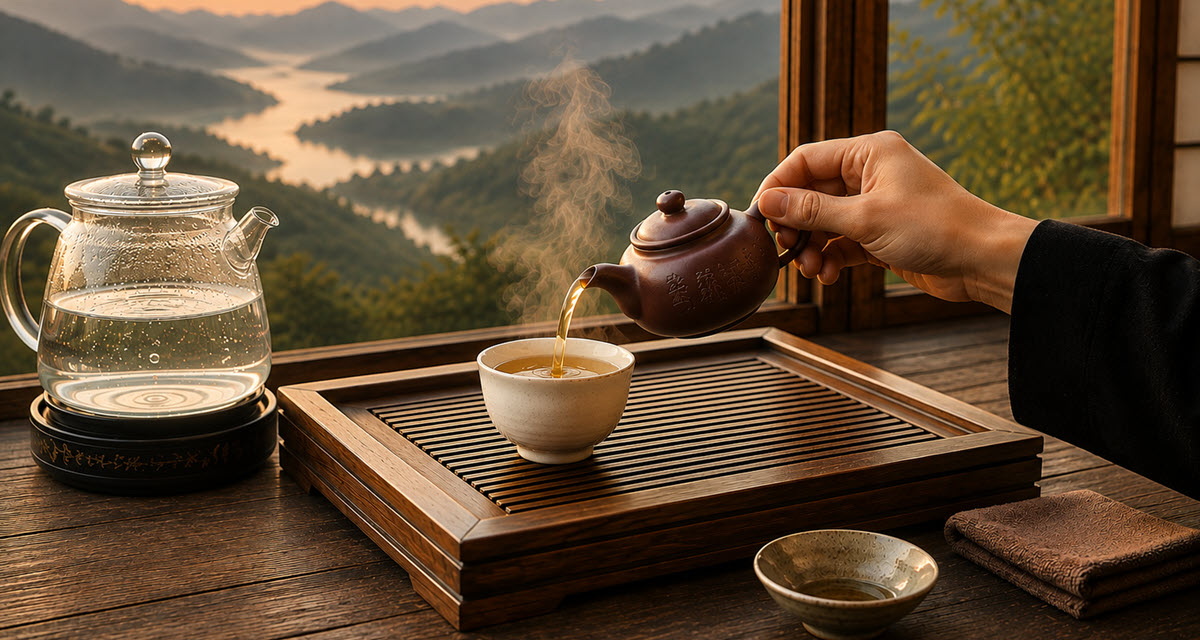
He placed some tea leaves in a small, delicate Kungfu teapot. Then he refilled a glass boiler with water and turned on the burner built into the tea table.
“Our body is like water,” he said. “Sometimes it is relaxed and flexible. Sometimes it is tight and frozen. When given heat, it boils. Too much heat, and it is exhausted. How do you feel today?”
“Tight and sore. Not quite frozen.”
“I see. Let’s see if we can follow the water to the tea leaves and to your body.”
He turned toward the water.
So did I.
At first, there was almost nothing to see. Then tiny bubbles appeared against the glass. Some loosened and floated upward, disappearing when they reached the surface. The sound changed as the water approached boiling, a fact I had never had reason to notice.
I poured the boiling water into the teapot. I felt the heat, saw the steam, and watched the leaves receive the water. They turned and slowly opened. Color moved outward from each leaf like ink entering still water.
I held the cup and felt the warmth enter my hands. The steam carried a mellow, earthy, slightly sweet scent.
I took a sip. It was too hot.
“Let it settle.”
So I did.
When I finally drank, I noticed the water that had been bubbling only moments before, and the tea leaves that had lived through many seasons.
I felt the warmth flow into my body, soothing and grounding. It was less an instant boost of energy than a gradual sense of coming alive.
No negotiations. No deadlines. No pushing toward what is next. And something in my body settled with it.
I do not want to make this moment larger than it was. I did not achieve enlightenment over a cup of tea on a mountain. I did not suddenly become a sage.
I simply noticed, for perhaps the first time in my adult life, what it felt like to nourish the body without asking it to perform in return.
I still love coffee.
But now I also love making tea. Not just drinking it, but making it from scratch. Making tea slowly that morning was not a transaction. It was not for anything. The making was the point. The sitting was the point. The settling was the point.
I now understand why he said, “Let’s get you ready.”
I could not have told you then what had shifted. I can barely tell you now. But something in the way I understood the body and energy began to change on that mountain, in that tea room, on a morning when there was nothing I needed to do and nowhere the day needed to go.
The steam rose.
I watched it disappear into the air.
I made another cup.